Energy & Renewables
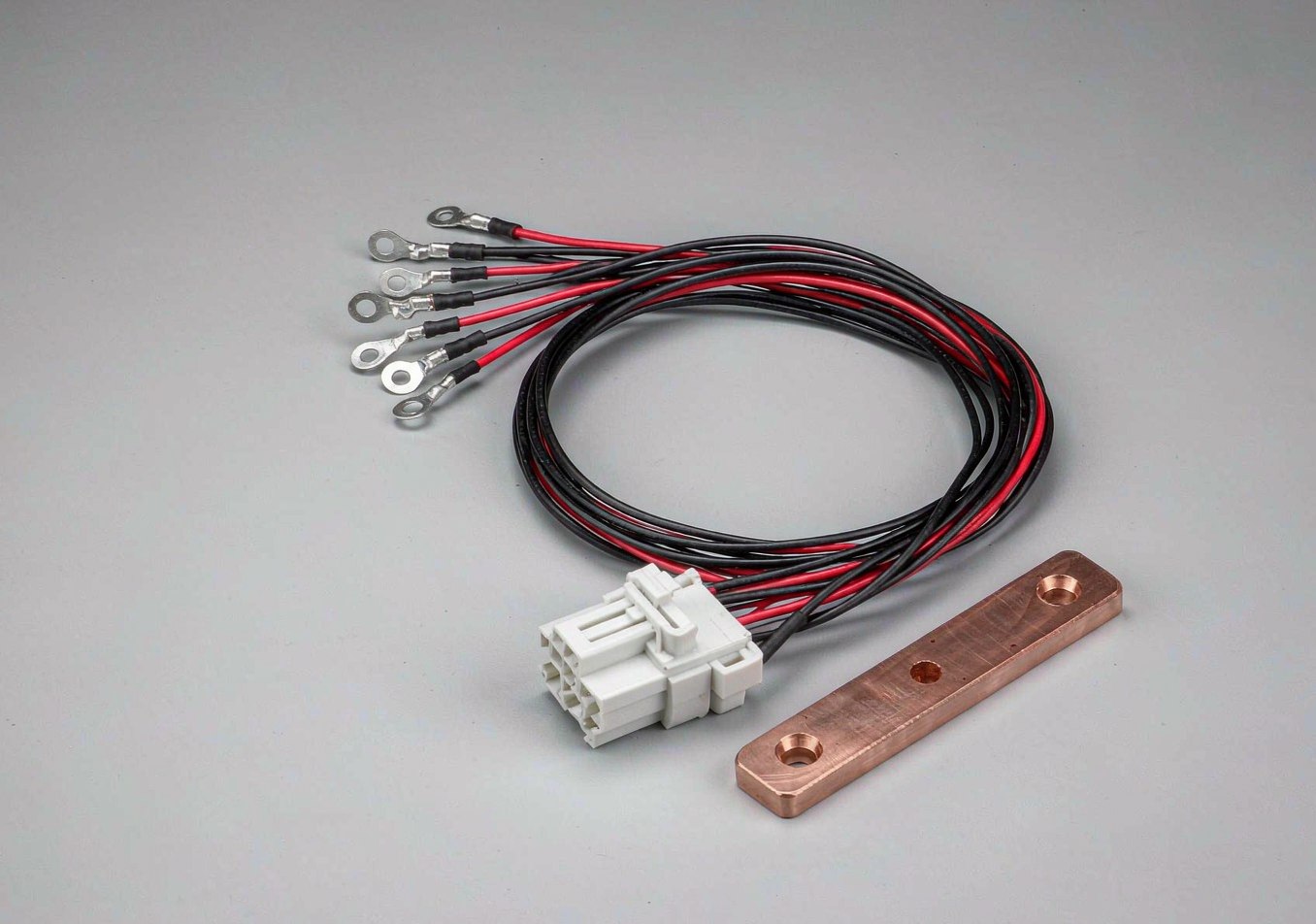
Energy Storage & BMS Harness
- Up to 1000 V DC on power circuits; 105 °C typical
- 8 to 120 sense positions in one harness, split across module groups
Battery management, energy-storage and photovoltaic harnesses, built on the 1000 V and 1500 V DC wire lines held in the wire catalogue.
Energy storage and photovoltaic harnessing is judged over a service life measured in decades rather than in cycles. A module sense harness has to keep its length match and its position identification for the life of the pack; a string harness has to keep its seal and its crimp integrity through twenty-five years of thermal cycling and ultraviolet exposure.
The wire is the deciding component. This group is built on the 1000 V and 1500 V DC lines that already carry published certificate references in the wire catalogue on this site — the TUV photovoltaic lines to EN 50618 and 2 PfG 1169, the UL 4703 photovoltaic wire, and the halogen-free XLPO and XLPE styles where a battery cabinet runs hot.
A battery pack needs three different harnesses and they are not interchangeable. The sense harness carries a few hundred milliamps at most and is selected on position accuracy: equal lead lengths from connector to cell, a wire that holds its strip length, and contacts that cannot be walked into the neighbouring position. The power interconnect carries the full string current and is selected on conductor cross-section, terminal temperature rise and the torque the stud can take.
The communication path is a third assembly. On most packs it is a shielded or twisted pair running the length of the cabinet, and it is the one that picks up noise when a contactor closes. It is terminated as a signal harness, with the drain landed deliberately, even though it physically lives in the same enclosure as the power cables.
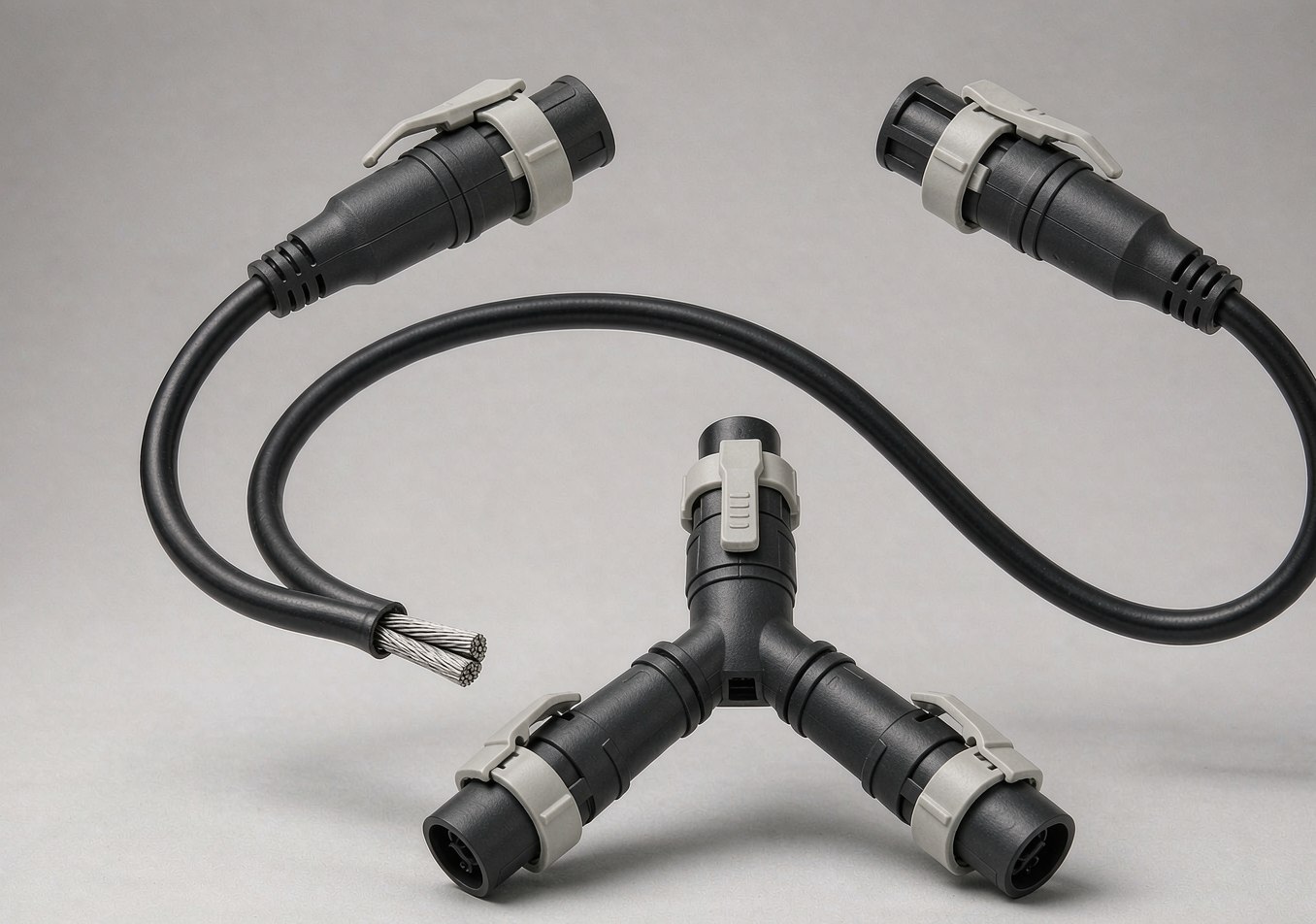
On the photovoltaic side the choice starts with the certificate the market demands: EN 50618 or IEC 62930 for Europe, UL 4703 for tray and exposed runs in North America, and a halogen-free XLPO or XLPE construction where the cable passes through a hot inverter enclosure. Connector compatibility is checked against the panel and the inverter side before anything is crimped, because a mismatched mating pair is a warranty argument rather than a defect that can be measured. Y-branch assemblies and pre-made string leads leave the shop with the same continuity record as any other harness.
Each line states the wire it is built on, the conductor range, the termination style and the inspection method.
Energy & Renewables
Energy & Renewables
What buyers ask before they send a drawing for this group.
Three. A module sense harness with equal-length leads and unambiguous position keying; a power interconnect sized on string current and stud temperature rise; and a communication harness built as a shielded or twisted pair with the drain terminated deliberately. In a containerised system the same three appear at pack level and at rack level, which is why the lengths and the labelling have to be planned together.
Length matching is a manufacturing discipline rather than a design note: the leads for one string are cut in a single batch to one measured length and bundled as a set, so a field replacement cannot introduce a mismatch. Polarity is made visible with both a colour scheme and a printed marker, and the connector keying is chosen so that a reversed insertion is physically impossible.
The cable carries the certificate rather than the assembly, and for Europe the reference is the EN 50618 photovoltaic cable standard; the TUV lines in this catalogue are held to it, with the IEC 62930 equivalents alongside. Where the run is also exposed in a tray in North America, UL 4703 photovoltaic tray cable is the matching line. Send the destination market and the exact line and its certificate reference will be named in the quotation.
Tell us the style, AWG, colour and quantity — or attach nothing and just describe the requirement. We reply to every enquiry.
Questions & answers
Certifications, lead time, payment, shipping and MOQ — the points buyers ask about most often. If something is still unclear, send us your requirement and we will answer directly. See the full FAQ →
We are a wire harness manufacturer — cutting, stripping, crimping, sealing and testing are all carried out in-house at our Suzhou plant. We are also an authorised distributor of Xinya brand electronic wire, so you can source both the wire and the finished harness from one supplier.
Our electronic wires carry UL, VDE, PSE and CE approvals, together with RoHS and REACH compliance for the European market; TUV approvals are available for PV and renewable-energy wire. Certificates and test reports are issued by the manufacturer and can be supplied with your quotation on request.
For electronic wire, popular styles such as UL1007, UL1015, UL1061 and UL1569 are normally available quickly; other styles, non-standard colours and cut lengths usually take around 7 days. Wire harnesses are made to order, so the schedule depends on your drawing, connector availability and quantity — we confirm it in the quotation.
We commonly accept T/T (telegraphic transfer), PayPal and Western Union. Typically a 30% deposit is required before production, with the balance paid before shipment.
Samples and small orders are shipped by international express (DHL, FedEx, UPS, TNT) or by air freight. Larger orders normally go by sea to reduce freight cost. We can quote EXW, FOB, CIF or door-to-door terms and will recommend the option that best fits your budget and delivery date.
We keep a low MOQ to support your business. Generally the MOQ is 1 piece for standard models, although it may vary slightly for customised products. Small trial orders are welcome.
Yes. We build to print and build to sample — send us a 2D drawing, a BOM, connector part numbers or even a photo of the part in use, and we will assemble, test and quote accordingly.
Yes. We are happy to build a prototype first so that you can approve the fit, crimp and finish before committing to volume. Send the drawing and the target quantity and we will quote sample cost and lead time.
For wire: the style or UL number, AWG, voltage and temperature rating, insulation, conductor, colour and length. For harnesses: the drawing or BOM, connector brand and part number, terminal and housing type, wire specification, cut length and tolerance, sleeving or tubing, label and packaging requirements, quantity and destination. If anything is unclear we will ask — or propose a construction for you.
Yes. We work with customer-specified connectors and brands as well as JST, Molex and HongXing, and can add printed markers, custom labels, printed bags and your own carton artwork for OEM and ODM projects.
Every order goes through incoming wire inspection, cutting and stripping checks, crimp height and terminal pull-force testing, 100% continuity and open-and-short testing, and a final dimensional and visual inspection. Inspection records can be supplied with the shipment when your project requires them.
Yes — our engineers help match wire gauge, insulation and temperature rating to your current, voltage and working environment, and select a terminal and housing combination that crimps reliably. Describe the application or send a sample and we will propose a construction.
Yes. Wire can be supplied in cut lengths, coils or spools, with PE bags, cartons, pallets and printed labels arranged to suit your warehouse or production line.
We ship worldwide, with regular shipments to Europe, North America, South-East Asia, the Middle East and Australia. You are welcome to visit our plant in Suzhou, and you can see our production lines in the factory videos on this site.
Contact us with the order or batch number and photos of the issue. We will check it against our production and inspection records and, where the fault is confirmed on our side, arrange replacement or credit.
Send the style, AWG range, colour and length — or your BOM and drawing. We will come back with construction, availability and lead time. This catalogue publishes no prices; every enquiry is quoted directly.
Request a quote