Industrial & Automation
Industrial Control & Machine Harness
- Up to 600 V and 105 °C; 1000 V on UL1032 where the panel needs it
- 2 to 120 conductors per loom, single and double ended
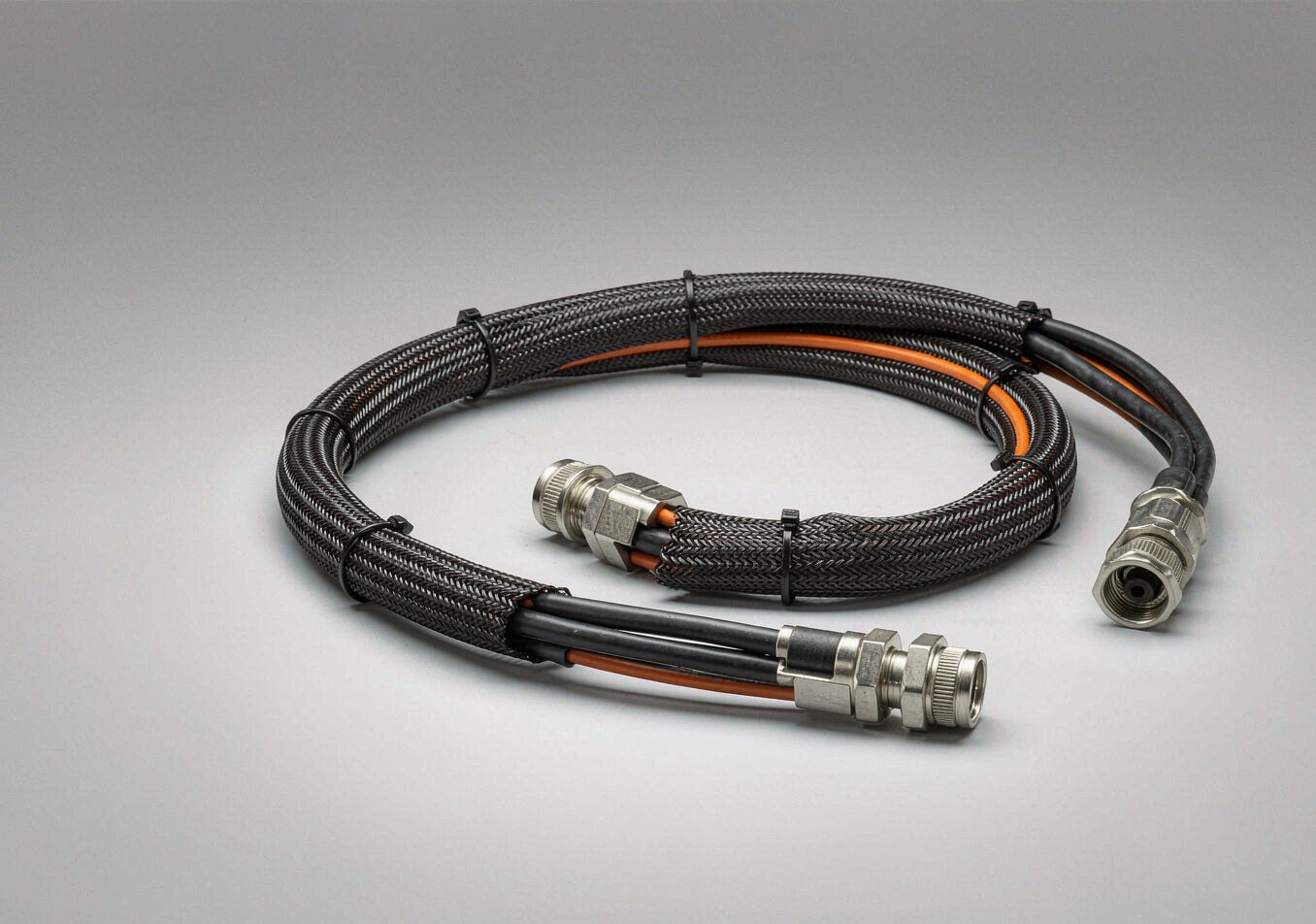
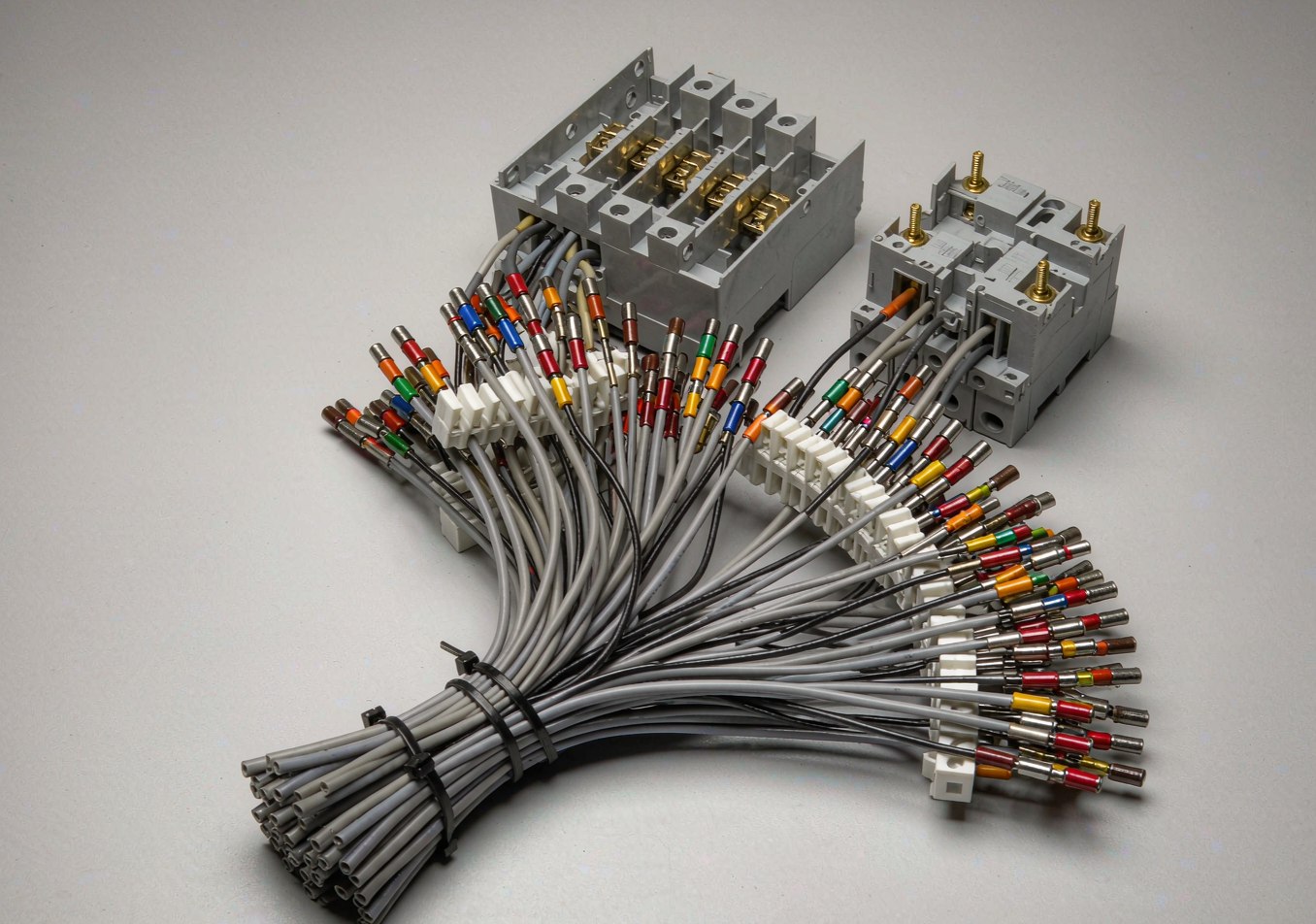
Control-panel, machine and continuous-flex harnesses with ferruled conductors, printed circuit identification and terminated shields.
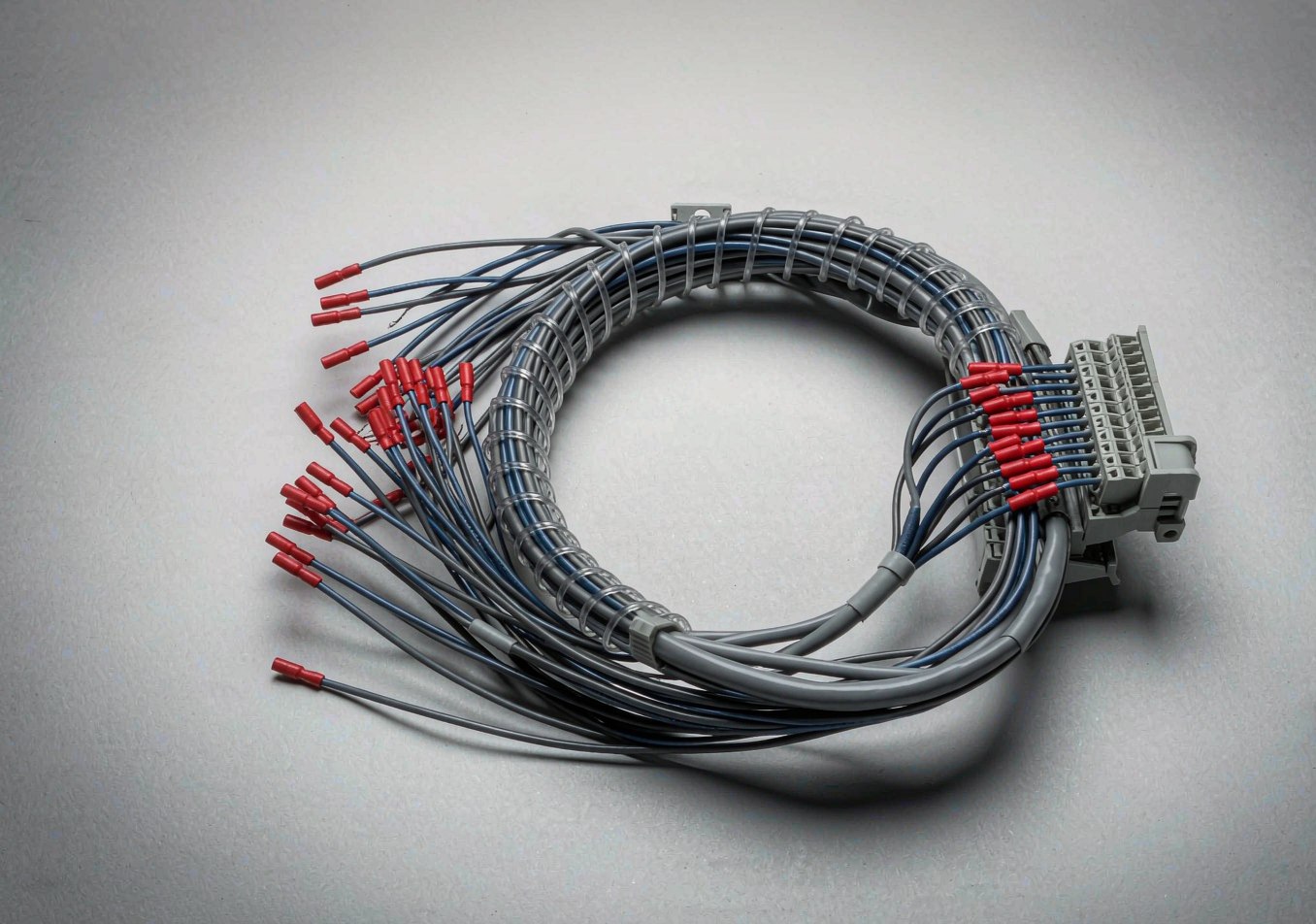
In a factory the harness is usually the last item on the critical path. Pre-forming the looms moves that work off a step ladder in a switchroom and onto a bench where the conductor can be stripped, ferruled, measured and rung out without anyone reaching over live equipment.
Two details separate a loom that works from one that wastes an engineer’s afternoon. The first is the ferrule: every stranded conductor landing in a cage or spring terminal should have one, crimped with the correct profile. The second is identification, printed and keyed to the schematic. Neither is expensive and both are routinely skipped.
The group splits into two kinds of work. A panel loom is static: it is built to a drawing, measured against a mounting plate, and its wire is chosen on voltage, temperature and how it behaves in a terminal — UL1015 or UL1007 for a North American panel, H05V-K or H07V-K where the machine is sold in Europe and the internal wiring has to satisfy the harmonised standard. A machine loom on a moving axis is a different problem, and it is built on the continuous-flex shielded multi-conductor lines: UL2464, UL2587, UL20276, UL20327 and the wider drag-chain family.
Ferrules are chosen to the terminal rather than to the wire. A DIN 46228 part with the correct sleeve length is what makes the joint, and the crimp tool has to match the ferrule profile — a generic plier that closes the barrel without forming it is the origin of most loose-conductor faults found in a finished panel. Where the conductor is fine-stranded for flex, the same rule applies with a longer ferrule to spread the load.
A loom leaves the shop with a from-to schedule, the ferrule map, a continuity record for every position, and split points chosen so that the assembly passes through the door and around the machine frame. Circuit identification is printed on sleeves rather than hand-marked, because a hand-marked core is unreadable after two years in a switchroom, and the same identification is repeated in the drawing package returned with the part.
Each line states the wire it is built on, the conductor range, the termination style and the inspection method.
Industrial & Automation
Industrial & Automation
Industrial & Automation
What buyers ask before they send a drawing for this group.
A ferrule is for a conductor that lands in a clamp, cage or spring terminal; a ring or fork terminal is for a stud. The two are not interchangeable, and the failure mode when they are confused is a joint that looks tight and loosens under thermal cycling. In a mixed panel both are used on the same core, driven from the from-to list.
The continuous-flex shielded multi-conductor lines — UL2464, UL2587, UL20276, UL20327 and the rest of the drag-chain family — because the flex rating, not the conductor size, decides the life of the assembly in a chain. The bend radius imposed by the chain is the number that matters, and a standard PVC hook-up wire will pass a continuity check on day one and fail at the connector within a few hundred thousand cycles.
Yes, and it is the usual way for repeat builds. The loom is formed on a board to the panel layout, the branches are cut to the measured lengths, and every core carries a printed sleeve before the assembly is bundled and bagged. On site it is laid into the duct and terminated, which removes the measuring and marking step from the electrician’s task.
Tell us the style, AWG, colour and quantity — or attach nothing and just describe the requirement. We reply to every enquiry.
Questions & answers
Certifications, lead time, payment, shipping and MOQ — the points buyers ask about most often. If something is still unclear, send us your requirement and we will answer directly. See the full FAQ →
We are a wire harness manufacturer — cutting, stripping, crimping, sealing and testing are all carried out in-house at our Suzhou plant. We are also an authorised distributor of Xinya brand electronic wire, so you can source both the wire and the finished harness from one supplier.
Our electronic wires carry UL, VDE, PSE and CE approvals, together with RoHS and REACH compliance for the European market; TUV approvals are available for PV and renewable-energy wire. Certificates and test reports are issued by the manufacturer and can be supplied with your quotation on request.
For electronic wire, popular styles such as UL1007, UL1015, UL1061 and UL1569 are normally available quickly; other styles, non-standard colours and cut lengths usually take around 7 days. Wire harnesses are made to order, so the schedule depends on your drawing, connector availability and quantity — we confirm it in the quotation.
We commonly accept T/T (telegraphic transfer), PayPal and Western Union. Typically a 30% deposit is required before production, with the balance paid before shipment.
Samples and small orders are shipped by international express (DHL, FedEx, UPS, TNT) or by air freight. Larger orders normally go by sea to reduce freight cost. We can quote EXW, FOB, CIF or door-to-door terms and will recommend the option that best fits your budget and delivery date.
We keep a low MOQ to support your business. Generally the MOQ is 1 piece for standard models, although it may vary slightly for customised products. Small trial orders are welcome.
Yes. We build to print and build to sample — send us a 2D drawing, a BOM, connector part numbers or even a photo of the part in use, and we will assemble, test and quote accordingly.
Yes. We are happy to build a prototype first so that you can approve the fit, crimp and finish before committing to volume. Send the drawing and the target quantity and we will quote sample cost and lead time.
For wire: the style or UL number, AWG, voltage and temperature rating, insulation, conductor, colour and length. For harnesses: the drawing or BOM, connector brand and part number, terminal and housing type, wire specification, cut length and tolerance, sleeving or tubing, label and packaging requirements, quantity and destination. If anything is unclear we will ask — or propose a construction for you.
Yes. We work with customer-specified connectors and brands as well as JST, Molex and HongXing, and can add printed markers, custom labels, printed bags and your own carton artwork for OEM and ODM projects.
Every order goes through incoming wire inspection, cutting and stripping checks, crimp height and terminal pull-force testing, 100% continuity and open-and-short testing, and a final dimensional and visual inspection. Inspection records can be supplied with the shipment when your project requires them.
Yes — our engineers help match wire gauge, insulation and temperature rating to your current, voltage and working environment, and select a terminal and housing combination that crimps reliably. Describe the application or send a sample and we will propose a construction.
Yes. Wire can be supplied in cut lengths, coils or spools, with PE bags, cartons, pallets and printed labels arranged to suit your warehouse or production line.
We ship worldwide, with regular shipments to Europe, North America, South-East Asia, the Middle East and Australia. You are welcome to visit our plant in Suzhou, and you can see our production lines in the factory videos on this site.
Contact us with the order or batch number and photos of the issue. We will check it against our production and inspection records and, where the fault is confirmed on our side, arrange replacement or credit.
Send the style, AWG range, colour and length — or your BOM and drawing. We will come back with construction, availability and lead time. This catalogue publishes no prices; every enquiry is quoted directly.
Request a quote