Xinya Blog / Oct 20, 2026
Wire Harness Cost: 7 Factors That Change Your Quotation
Tags: Connector Selection, Crimp Quality, Wire Harness Assembly, Wire Harness Cost, Wire Harness Quotation, Wire Harness RFQ
Wire harness cost is set by seven factors: wire style and gauge, terminal and connector choice, length and branch count, order quantity, test and documentation level, mechanical protection, and packaging and freight. Wire and terminals usually account for 50-60% of the unit price; labour and test time decide the rest.
That is why two quotations for the same drawing can differ by 30% and both be honest. One quoted UL1007, an unsealed connector and a continuity check; the other quoted 105°C XLPE, a sealed connector and a full first-article report.
Use it to read a quotation, challenge a line item, or write an RFQ that returns comparable numbers.
What actually drives a wire harness quotation?
A harness is priced from four pools: material, labour, test, and overhead plus freight. Material is the largest and most visible. Labour hides in the per-termination time, which is where a ten-branch harness quietly becomes expensive.
Only one pool is negotiable. The other three were fixed at the drawing stage, and they can still be changed there at no cost.
The seven cost factors at a glance
The shares below are indicative ranges from typical industrial builds, not a price list; a 30 mm harness and a 3 m harness do not split the same way.
| Cost factor | What changes the price | Typical share of unit price | Where the buyer has leverage |
|---|---|---|---|
| Wire style and gauge | Insulation material, temperature class, stranding, tinning | 20-35% | Specify the lowest rating that meets the environment |
| Terminals and connectors | Brand, plating, sealed or unsealed, applicator tooling | 15-30% | Allow an approved equivalent where the housing is not critical |
| Length and branches | Number of terminations, wire waste, cut-and-strip cycles | 10-20% | Realistic tolerance, one measuring convention |
| Order quantity | Setup time, tooling amortisation, material minimums | 10-25% spread | Batch size, blanket order, annual volume commitment |
| Test and documentation | Continuity, dielectric withstand, pull force, first-article report | 5-12% | Define the test level once, per drawing |
| Protection and sealing | Braid, sleeving, heat shrink, overmoulding, IP class | 8-20% | Apply only where the environment actually requires it |
| Packaging and freight | Labelling, reels, carton size, Incoterms, export documents | 3-8% | Consolidate shipments, agree the Incoterm early |
How does wire style change the price?
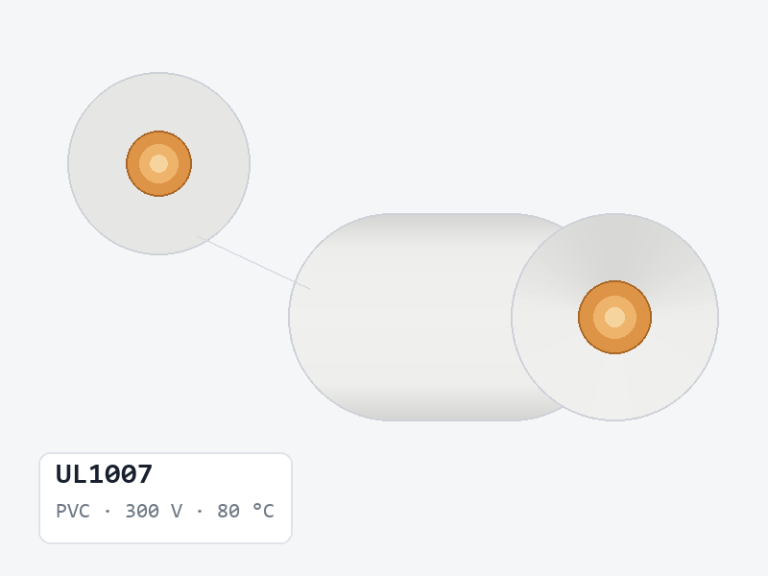
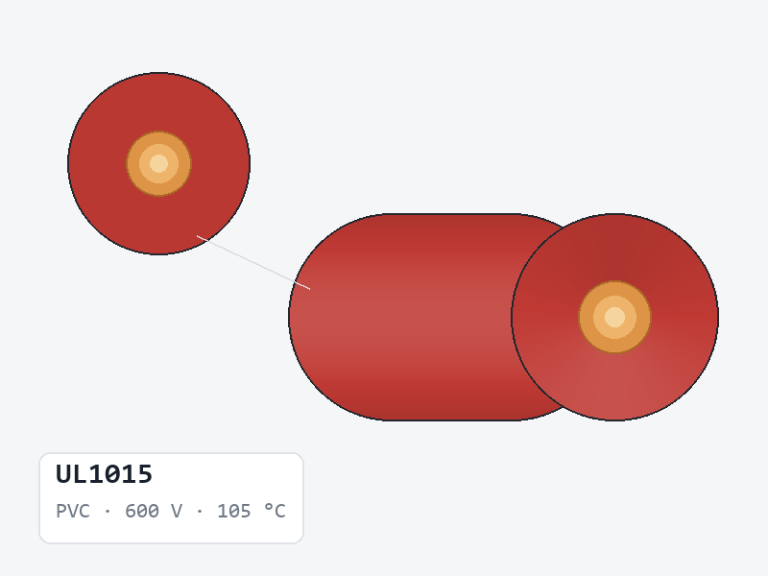
Wire style is the largest material decision. UL1007 is 80°C, 300 V thin-wall PVC and the cheapest common choice. UL1015 is 105°C, 600 V with a thicker wall. XLPE styles such as UL3266 and UL3398, and fluoropolymer styles such as UL1330 FEP, sit in a higher bracket again.
Three details inside the same style still move the number:
- Stranding. A 22 AWG conductor can be built as 7 strands or a much finer bunch. Finer stranding costs more but survives flexing; a static panel harness rarely needs it.
- Tinned versus bare copper. Tinning adds a real premium per kilogram and matters in humid or high-temperature service. It is wasted money inside a dry enclosure.
- Colour and print. Ten colours from stock are cheap. A custom colour with a printed legend on every metre is not, and it raises the material minimum.
Our UL PVC hook-up wire family and XLPE hook-up wire family pages publish the construction table for each style, the wire selector filters by voltage, temperature and approval, and UL1007 versus UL1015 covers the two PVC workhorses.
Do connectors and terminals really move the price?
Yes, and on short harnesses they move it more than the wire does. A 300 mm assembly with two connector halves can carry 40% of its material cost in the housings and terminals. Sealed connectors typically cost two to three times their unsealed equivalents and need a different applicator.
The brand is a cost question. JST, Molex and HongXing families are widely available, and an approved equivalent with the same pitch and plating often quotes lower and ships faster. Where the housing is customer-specified, that part’s lead time becomes the harness lead time.
Terminal choice decides tooling. A standard open-barrel terminal runs on a standard applicator; a non-standard terminal needs a dedicated one, charged either as an amortised cost or as one-time tooling. Ask which.
What pull force should a crimp hold?
Crimp quality is verified by pull force, and the acceptance value comes from the terminal maker’s specification, not from a generic rule. The figures below are typical minimums used during first-article checks.
| Conductor size | Typical minimum crimp pull force |
|---|---|
| 22 AWG | 45 N |
| 20 AWG | 70 N |
| 18 AWG | 90 N |
| 16 AWG | 130 N |
| 14 AWG | 220 N |
| 12 AWG | 310 N |
A crimp that looks correct and fails at 60% of the specified force is the most expensive kind of defect, because it reaches the customer. Our terminal-crimped wire leads page covers crimp height and pull-force routine, and the specification logic is in the 12-point harness specification checklist.
How do length, branch count and routing add cost?
Every branch adds terminations, and terminations are where labour lives. A single 1 m lead has two ends. A ten-branch harness with a common connector has eleven connector positions and twenty or more crimped contacts, plus branch joints, sleeving cuts and handling between stations.
Two numbers explain most of the variance: termination count and time per termination. Automated cut-and-crimp stations run a few seconds per end; manual work on a small batch runs far longer.
Length tolerance is the quiet cost. ±10 mm forces a measured cut on every lead; ±25 mm on a panel harness allows a programmed cut and less scrap.
Why does order quantity change the unit price so much?
Setup does not scale. Each wire style needs a machine setup, each connector a reel or tube loaded, and the first piece a check. On a small batch that setup spreads over a few hundred units; at volume it disappears into material cost.
Moving from 100 to 1,000 pieces of a mid-complexity harness often takes 20-35% out of the unit price. The curve then flattens, because material dominates and material does not get cheaper with volume. A blanket order with scheduled releases usually beats one large shipment.
What do testing and documentation add?
Testing is the cheapest insurance in the quotation and the first line item buyers delete. The basic routine is 100% continuity on every circuit plus a dielectric withstand test, commonly 500 V DC on low-voltage harnesses and never above the rating of the lowest-rated component.
Above that come sample pull force per batch, dimensional checks on the first piece, and a first-article report with the measurements written down. A full report pack typically adds 5-12% to the unit price, and it settles who is responsible when a harness fails at the customer’s line. The FAQ page covers the acceptance questions we are asked most often.
How much do protection, overmoulding and sealing cost?
Protection is priced by the metre and by the operation. Braid, spiral wrap and heat shrink are material plus labour, and heat shrink adds a step per branch. Overmoulding needs a tool, a one-time cost that only pays above a certain annual volume.
Sealing is the expensive end. IP67 or IP68 needs sealed connectors, interface seals, correct grommet sizing and often potting or a moulded boot, plus a test that proves the seal. Specify the class the installation actually sees; an indoor cabinet harness rated IP68 pays for water resistance it never uses.
Our over-moulded cable assembly page explains where moulding replaces a separate boot, and continuous-flex routes are covered under robotics and drag chain harnesses.
What about packaging, labelling and freight?
This is the smallest pool and the one that causes the most disputes. Harnesses are bulky and light, so cartons go volumetric and freight is charged on space. Label content, barcode format and label position are specification items.
Agree the Incoterm before the quotation. EXW, FOB and DDP produce three different totals for the same goods, and comparing them as one number is the most common mistake in a quotation review.
How to compare two harness quotations fairly
Put both quotations against the same eight checks. Most price gaps collapse once the differences are named, and the ones that remain are real.
- Wire style and temperature class — the same UL style number, not just the same AWG.
- Connector brand and plating — equivalent family, or a different one.
- Termination count — count on the drawing, not on the BOM summary.
- Length tolerance and measuring convention — pin to pin, or overall including connectors.
- Test level — continuity only, or continuity plus dielectric withstand plus pull force.
- Documentation — first-article report included or extra.
- Tooling and setup — amortised into the unit price, or invoiced once.
- Packaging, labelling and Incoterm — the delivered total, not the ex-works number.
Send those eight points with the RFQ and every reply becomes comparable. The wire harness configurator builds that specification sheet from a set of dropdowns, including the wire recommendation and the branch list.
Where to start
Send the drawing, the BOM or a physical sample. Suzhou Fuxi Electromechanical Equipment Co., Ltd. (Xinya) has assembled custom wire harnesses since 2008 and is the authorised distributor of Xinya Electronic Co., Ltd. electronic wire, so the wire and the finished assembly are specified together.
We build to print and build to sample, and we quote prototypes below production volume so the first article is approved before tooling is committed. Common UL1007, UL1015, UL1061 and UL1569 constructions are normally available quickly; other styles and connector families typically run about seven days, and harness assemblies are scheduled against the drawing and the approved sample. Start with the request a quote form, browse the wire harness catalogue, or watch the assembly and test stations on the factory video page. Buyers who need an application view can start from industrial automation or assembly services.
Frequently asked questions
How much does a custom wire harness cost?
There is no catalogue price, because the same drawing can be built at several specification levels. Material is usually 50-60% of the unit price, with wire and terminals dominating. Send the drawing or the eight-point summary above and the number comes back against a defined specification.
Why is my new quotation higher than the last supplier’s?
Usually because it is a different product. Check the wire style, connector brand, test level and whether tooling was amortised. A quote 30% lower often uses a thinner insulation class, an unsealed connector or continuity testing only.
Can you quote from a sample instead of a drawing?
Yes. Send the sample, or clear photographs with a ruler in view, and note anything that must change. We reverse the specification from the sample, confirm the wire styles and connector families, and quote against that confirmed list.
What is the minimum order quantity?
It depends on the connector and the wire style, because both carry supplier minimums. Prototype quantities are quoted separately from production, and a blanket order with scheduled releases is often the cheapest route to a production price.
How long does production take?
Common UL1007, UL1015, UL1061 and UL1569 constructions are normally available quickly. Other wire styles and connector families typically take about seven days, and every harness is scheduled against its drawing and approved sample.
Do you supply the wire and connectors, or only assemble?
Both. We are the authorised distributor of Xinya Electronic Co., Ltd. electronic wire, so the wire is specified with full construction data, and we source standard JST, Molex and HongXing families or build with parts you specify or supply.
Can you reduce the cost of a harness we already buy?
Often. The usual levers are consolidating several wire styles into one, allowing an approved equivalent connector, relaxing a tolerance the installation does not need, and increasing the batch size. Each change is documented so drawing and price stay in step.